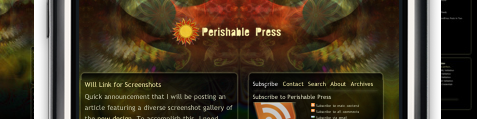
One of my goals for the new Perishable Press redesign was to achieve cross-browser, pixel-perfect precision1. Of course, due to many variables (platform, operating system, browser, extensions, fonts, etc.), it is virtually impossible to achieve complete 100% perfection, but I am certainly interested in examining the design on as many different configurations as possible. Thus, last week after launching the new design, I made an open call for screenshots. Graciously, many of you responded with some great screenshots. Thanks to […] Continue reading »
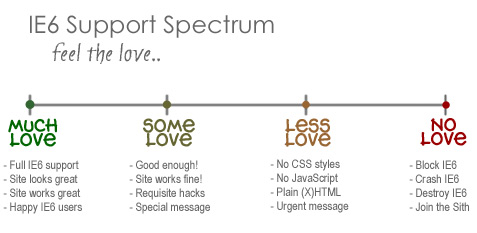
I know, I know, not another post about IE6! I actually typed this up a couple of weeks ago while immersed in my site redesign project. I had recently decided that I would no longer support that terrible browser, and this tangential post just kind of “fell out.” I wasn’t sure whether or not to post it, but I recently decided to purge my draft stash by posting everything for your reading pleasure. Thus, you may see a few turds […] Continue reading »
Quick announcement that I will be posting an article featuring a diverse screenshot gallery of the new design. To accomplish this, I need screenshots from as many different operating systems and browsers as possible. Currently, I have access to the following browsers: Continue reading »
New design in effect at Perishable Press. With this 17th incarnation of the site, I drew heavily upon psychedelic influences, spiked it with the essence of the previous dark minimalist theme, and mixed in a healthy dose of cutting-edge JavaScript and PHP functionality. Continue reading »
As announced at IE Death March, I recently dropped support for Internet Explorer 6. As newer versions of Firefox, Opera, and Safari (and others) continue to improve consistency and provide better support for standards-based techniques, having to carry IE 6 along for the ride — for any reason — is painful. Thanks to the techniques described in this article, I am free to completely ignore (figuratively and literally) IE 6 when developing and designing websites. Continue reading »
An ongoing series of articles on the fine art of malicious exploit detection and prevention. Learn about preventing the sneaky mischievous and deceptive practices of some of the worst spammers, scrapers, crackers, and other scumbags on the Internet. Continue reading »
Here at Perishable Press, I love to write about minimalism, simplicity, and usability in user-interface and web design. I have always enjoyed the minimalist aesthetic, as my Perishable Theme plainly illustrates. Fortunately, many designers and developers have embraced the minimalist concept, and continue to produce and promote minimalist design principles in their designs. As often as my schedule allows, I like to take the time to explore and share some of my favorite minimalist designs, and so far have managed […] Continue reading »
As my readers know, I spend a lot of time digging through error logs, preventing attacks, and reporting results. Occasionally, some moron will pull a stunt that deserves exposure, public humiliation, and banishment. There is certainly no lack of this type of nonsense, as many of you are well-aware. 3G Blacklist Even so, I have to admit that I am very happy with my latest strategy against crackers, spammers, and other scumbags, namely, the 3G Blacklist. Since implementing this effective […] Continue reading »
My favorite series of articles here at Perishable Press, the “Obsessive CSS Code Formatting” articles explore the esoteric minutia involved with producing clean, well-formatted CSS code. From indention and spacing to opening and closing brackets, the obsessive CSS code series explores techniques and tricks used to transform ordinary stylesheets into streamlined masterpieces of inspiring beauty. Creating poetic CSS integrates the high art of employing consistent coding patterns and formatting methods with the practical functionality of proper syntax, logical structure, and […] Continue reading »
After announcing my intention to redesign Perishable Press, I received some great feedback addressing everything from site architecture and navigation to appearance and usability. As the conversations continue, I want to spend some time thinking about usability, navigation, columns and sidebars. The current minimalist design features a single column layout with no sidebars. Content is located prominently front and center, with all navigational links appearing in either the oversized “footer” area or at the end of each individual post. As […] Continue reading »
I want to redesign Perishable Press. The current design was released around a year ago, and has received numerous compliments and criticisms. Compliments tend to focus on the theme’s minimalist sensibilities, while criticism is generally directed at the design’s poor usability. Personally, I find the “grey-on-black” color scheme to be very inspiring. Others, however, have difficulties reading the content, and that’s not good. Continue reading »
It’s been awhile since my last personal news post, and I figure that enough has been happening to warrant yet another exciting news update. Yay! ;) So let’s see, first on my mind is the recent launch of the new design for Monzilla Media, the official site for my personal website and graphic design business. The first two versions of the site were single-page brochure sites, but this new version is fully loaded, featuring tons of portfolio content, business news, and […] Continue reading »
Hmmm.. Let’s see here. Google can do it. MSN/Live can do it. Even Ask can do it. So why oh why can’t Yahoo’s grubby Slurp crawler manage to adhere to robots.txt crawl directives? Just when I thought Yahoo! finally figured it out, I discover more Slurp tracks in my Blackhole trap for bad spiders: Continue reading »
This was just too juicy to pass up. Blogstorm recently blogged about an easy JavaScript technique for making any website editable. After checking it out for myself, I just had to share it here at Perishable Press. Here it is: javascript:document.body.contentEditable='true'; document.designMode='on'; void 0 Paste that single line of code into the address bar of any modern browser and have fun editing the page. Obviously, any changes will only apply to the page as seen in your browser, not the […] Continue reading »
![[ Count Chimpula ]](https://perishablepress.com/wp/wp-content/images/2008/misc-chunks/verify-feedcount.jpg)
Recently, I received a bizarre email accusing me of calling someone out on their fake Feedburner subscriber count. Apparently, some desperate blogger had been claiming to have something like 30,000 Feedburner subscribers when in reality they only had around 700. From what I could tell, the fraudulent site was displaying a counterfeit Feedburner subscriber-count badge using some fancy CSS image-replacement or something. Whatever. I really could care less, but the information contained in the email got me thinking: Providing an […] Continue reading »
![[ Thumbnail: Google W3C Invalidation ]](https://perishablepress.com/wp/wp-content/images/2008/google-check/google-invalidation_mid.gif)
Consider the Google home page — arguably the most popular, highly visited web page in the entire world. Such a simple page, right? You would think that such a simple design would fully embrace Web Standards. I mean, think about it for a moment.. How would you or I throw down a few lists, a search field, and a logo image? Something like this, maybe: Continue reading »

 Perishable Press is operated by Jeff Starr, a professional web developer and book author with two decades of experience.
Here you will find posts about web development, WordPress, security, and
Perishable Press is operated by Jeff Starr, a professional web developer and book author with two decades of experience.
Here you will find posts about web development, WordPress, security, and