Once again I am cleaning up my sites’ .htaccess files. I do this from time to time to remove old redirects, refresh blacklists, and update security and SEO-related directives. It’s tedious work, but the performance and security benefits make it all worthwhile. This post shares some of the techniques that were added, removed, or replaced from .htaccess, and explains the reasoning behind each decision. I do this for the sake of reference, and hopefully it will give you some ideas […] Continue reading »
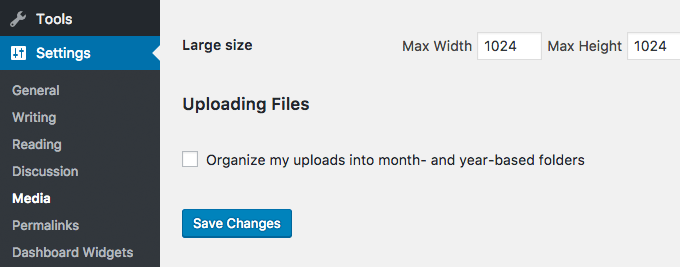
In this tutorial, I’m going to walk you through how you can add a new menu in WordPress Admin Area, where your users will be able to import any demo content — including widgets, their positions and navigation as well — by a single click. The code follows the best WordPress practices, uses WP Filesystem for file management, includes escaping and all text strings are prepared for translation. It also passes the WordPress theme check plugin! Continue reading »
![[ Perishable Press : Stop WordPress from modifying .htaccess ]](https://perishablepress.com/wp/wp-content/images/2019/wordpress-htaccess.jpg)
By default, depending on file permissions, WordPress automatically will modify the contents of your site’s .htaccess file. It does this on several occasions, adding and/or updating the rewrite rules required for WP’s permalink functionality. This post explains how this works, why it can be dangerous, and how to stop it from happening. Continue reading »
![[User Enumeration ]](https://perishablepress.com/wp/wp-content/images/2016/user-enumeration.jpg)
This tutorial explains how to block user-enumeration scans in WordPress. As explained in greater depth here, user enumeration happens when some malicious script scans a WordPress site for user data by requesting numerical user IDs. For example, requests for author=1 through some number, say, author=1000, may reveal the usernames for all associated users. With a simple enumeration script, an attacker can scan your site and obtain a list of login names in a matter of seconds. Continue reading »
![[ RSSing.com Removal Request or Whatever ]](https://perishablepress.com/wp/wp-content/images/2016/rssing-com.jpg)
This quick post explains how to stop the notorious site scrapers, RSSing.com, from stealing your content. In fact, this technique can be used to stop virtually any site that uses HTML frames to scrape your pages. Once again, the solution is one line of .htaccess to the rescue. Continue reading »
![[ Two Passwords = Two Bad ]](https://perishablepress.com/wp/wp-content/images/2016/he-man-two-bad.jpg "Two Bad")
Image courtesy of eChunks.com Here is a quick security tip for people using popular apps on the Web. That is, apps like WordPress that may be widely used and targeted by bad actors and/or automated scripts. It’s all about adding another layer of security by hardening admin-level usernames.. Every now and then, I get an email letting me know that someone has requested a password reset for one of my admin-level WordPress accounts. Usually, the email notifications are sent directly […] Continue reading »
![[ 6G Firewall ]](https://perishablepress.com/wp/wp-content/images/2016/6G-firewall.png)
After three years of development, testing, and feedback, I’m pleased to announce the official launch version of the 6G Firewall (aka the 6G Blacklist). This version of the nG Firewall is greatly refined, heavily tested, and better than ever. Fine-tuned to minimize false positives, the 6G Firewall protects your site against a wide variety of malicious URI requests, bad bots, spam referrers, and other attacks. Blocking bad traffic improves site security, reduces server load, and conserves precious resources. The 6G […] Continue reading »
I use s2member (free version) and s2member Pro on a few of my sites. Have been for several years now. Over the course of time, I have amassed a healthy collection of notes, code snippets and techniques for customizing default functionality, adding features, and so forth. Gonna post the collection online for the benefit of any others who may be seeking for similar modifications and/or related information. Continue reading »
One of the most annoying, persistent scans I’ve seen in a long time are those hunting for the revslider vulnerability. In the five or so months since the exploit was discovered, many sites have been compromised. And based on what I’ve been seeing in my traffic logs, the risk is far from over. Apparently every 2-bit script kiddie and their pet hamster wants a piece of the “revslider action”. Continue reading »
![[ Protect yourself ]](https://perishablepress.com/wp/wp-content/images/2014/gas-mask-dog.jpg)
Whether you like it or not, there are scripts and bots out there hammering away at your sites with endless HTTP “POST” requests. POST requests are sort of the opposite of GET requests. Instead of getting some resource or file from the server, data is being posted or sent to it. To illustrate, normal surfing around the Web involves your browser making series of GET requests for all the resources required for each web page. HTML, JavaScript, CSS, images, et […] Continue reading »
![[ WP Plugin: Core Control ]](https://perishablepress.com/wp/wp-content/images/2014/core-control.gif)
Just a quick post with some tips for troubleshooting and testing HTTP requests. For example, if you have a plugin that sends requests behind the scenes via Ajax or cURL or whatever, it’s nice to have a way to view request details such as headers, the response, and everything in between. This article is aimed primarily at WordPress users, but contains more general tips and tricks as well. Continue reading »
![[ Screenshot: PHP Logo ]](https://perishablepress.com/wp/wp-content/images/2012/php-easter-eggs-02a.jpg)
A reader recently brought to my attention a reported vulnerability on servers running PHP. It’s been known about for eons, but it’s new to me and it involves easter eggs in PHP so I thought it would be fun to share a quick post about what it is and how to prevent leakage of sensitive information about your server. It only takes a moment to disable the easter-egg information, should you decide to do so. Continue reading »
![[ 6G Blacklist (beta) ]](https://perishablepress.com/wp/wp-content/images/2012/6G-Blacklist.png)
Since releasing the 5G Blacklist earlier this year, malicious server scans and bad requests have surged with more novel attacks than I’ve seen since first getting into this stuff six years ago. In other words, now is the time to beef up security and lock things down. If you’re into monitoring your server and knowing your traffic, you may be observing the same recent spike in malicious activity. In response to these attacks, I’ve been secretly working on the next […] Continue reading »
Working on the next version of the G-Series Blacklist, I needed a way to match a wide variety of UTF-8-encoded (hex) character strings. Those familiar with their site’s traffic will recognize this particular type of URI request string, which is typically associated with malicious server scanning, exploits, and other malicious behavior. As I explain in this post, pattern-matching and blocking the blank-space, or whitespace character in URL-requests is an effective way to improve the security of your website. Continue reading »
Cool trick that you may not have known about.. it’s possible to get case-insensitive matching with the powerful RedirectMatch directive. Normally, you would just write your redirect as something like this: Continue reading »
Restructuring a WordPress website may involve removing the subdomain from URLs/permalinks. For example, I recently removed the original WP-install subdirectory from Perishable Press to simplify site structure and optimize WordPress permalinks. There are PHP scripts and WP plugins that might work for this, but in most cases .htaccess is optimal when changing URL structure and redirecting traffic. Here’s a quick example to help visualize the concept: Continue reading »
 Perishable Press is operated by Jeff Starr, a professional web developer and book author with two decades of experience.
Here you will find posts about web development, WordPress, security, and
Perishable Press is operated by Jeff Starr, a professional web developer and book author with two decades of experience.
Here you will find posts about web development, WordPress, security, and