Preloading images is a great way to improve the user experience. When images are preloaded in the browser, the visitor can surf around your site and enjoy extremely faster loading times. This is especially beneficial for photo galleries and other image-heavy sites where you want to deliver the goods as quickly and seamlessly as possible. Preloading images definitely helps users without broadband enjoy a better experience when viewing your content. In this article, we’ll explore three different preloading techniques to […] Continue reading »
![[ WordPress ]](https://perishablepress.com/wp/wp-content/images/2009/misc-chunks/wordpress-logo-blue.png)
One of the most popular articles here at Perishable Press is my January 2005 post, Stupid htaccess Tricks. In that article, I bring together an extensive collection of awesome copy-&-paste HTAccess code snippets. Four years later, people continue to tell me how much they enjoy and use the content as a bookmarked reference for many of their HTAccess needs. The article was even published in a book on Joomla! Security. This is very inspiring to me, so I have decided […] Continue reading »
If you operate a website that features lots of code examples, you know how important it is to spend some quality time styling the <pre></pre> element. When left unstyled, wild <pre></pre> tags will mangle your preformatted content and destroy your site’s layout. Different browsers treat the <pre></pre> tag quite differently, varying greatly in their default handling of font-sizing, scrollbar-rendering, and word-wrapping. Indeed, getting your preformatted code to look consistent, usable, and stylish across browsers is no easy task, but it […] Continue reading »
![[ Screenshot: Default Apache 404 Error Page ]](https://perishablepress.com/wp/wp-content/images/2009/pimp-your-404/404-not-found.png)
I have been wanting to write about 404 error pages for quite awhile now. They have always been very important to me, with customized error pages playing a integral part of every well-rounded web-design strategy. Rather than try to re-invent the wheel with this, I think I will just go through and discuss some thoughts about 404 error pages, share some useful code snippets, and highlight some suggested resources along the way. In a sense, this post is nothing more […] Continue reading »
![[ Twitter ]](https://perishablepress.com/wp/wp-content/images/2009/twitter-tricks/twitter-tricks_00.png)
Might as well face it, Twitter is here to stay. Not that it’s all that bad, just used to be a lot more laid-back and enjoyable. These days it seems to have been taken over by the lowest common-denominator, mostly high-school twits or useless commercial propaganda. Even so, I still enjoy tweeting the occasional profound thought once in awhile, and even like to play around with various types of “advanced” Twitter functionality. You know, cool stuff like including “Tweet This!” links […] Continue reading »
When developing the colorful Quintessential Theme (opens in new tab), I initially planned on displaying five random posts from each of my most popular tags and categories in the super-slick sliding-panel sidebar. Because I am running an older version of WordPress, however, this task proved to be quite the educational experience. In newer versions (from 2.5 I think) of WordPress, the query_posts() function enables users to display posts in random order using the orderby=rand parameter. This would have made my […] Continue reading »
![[ Dynamic Flow ]](https://perishablepress.com/wp/wp-content/images/2009/misc-chunks/dynamic-linkage.jpg)
In my recent guest post at The Nexus, I discuss Google’s new nofollow policy and suggest several ways to deal with it. In that article, I explain how Google allegedly has changed the way it deals with nofollow links. Instead of transferring leftover nofollow juice to remaining dofollow links as they always have, Google now pours all that wonderful nofollow juice right down the drain. This shift in policy comes as a terrible surprise to many webmasters and SEO gurus, […] Continue reading »
![[ Screenshot: The Legion of Doom ]](https://perishablepress.com/wp/wp-content/images/2009/misc-chunks/multiple-addresses.jpg)
Let’s face it. There’s just as much scum on the Internet as there is out there in the “real world.” Maybe even more, who knows. From scammers and spammers to scrapers and crackers, the Web is just crawling with all sorts of pathetic scumbags. As predictably random as much of the malicious activity happens to be, it is virtually guaranteed that you will be hounded by at least a few persistent IP addresses that, for whatever reason, have latched on […] Continue reading »
I finally broke down and uninstalled Alex King’s once-great “Popularity Contest” plugin for WordPress. The plugin had been active here at Perishable Press for over two years, and had provided fairly consistent and apparently accurate statistics while in service. Unfortunately, there were serious errors involved with the plugin way back during the WordPress-2.3 upgrade that were never addressed by the plugin author. There was an interim version of the plugin that had patched the error until an official update was […] Continue reading »
Normally, when visitors post a comment to your site, specific types of client data are associated with the request. Commonly, a client will provide a user agent, a referrer, and a host header. When any of these variables is absent, there is good reason to suspect foul play. For example, virtually all browsers provide some sort of user-agent name to identify themselves. Conversely, malicious scripts directly posting spam and other payloads to your site frequently operate without specifying a user […] Continue reading »
When designing sites, it is often useful to identify different pages by adding an ID attribute to the <body></body> element. Commonly, the name of the page is used as the attribute value, for example: <body id="about"></body> In this case, “about” would be the body ID for the “About” page, which would be named something like “about.php”. Likewise, other pages would have unique IDs as well, for example: <body id="archive"> </body><body id="contact"> </body><body id="subscribe"> </body><body id="portfolio"></body> ..again, with each ID associated […] Continue reading »
![[ Screenshot: WP Default Database Error Page ]](https://perishablepress.com/wp/wp-content/images/2009/install-security/h4x0rd_03.gif "Error establishing a database connection")
The other day, my server crashed and Perishable Press was unable to connect to the MySQL database. Normally, when WordPress encounters a database error, it delivers a specific error message similar to the following: Continue reading »
Importing and displaying external RSS feeds on your site is a great way to share your online activity with your visitors. If you are active on Flickr, Delicious, Twitter, or Tumblr, your visitors will enjoy staying current with your updates. Many social media sites provide exclusive feeds for user-generated content that may be imported and displayed on virtually any web page. In this article, you will learn three ways to import and display feed content on your WordPress-powered website — […] Continue reading »
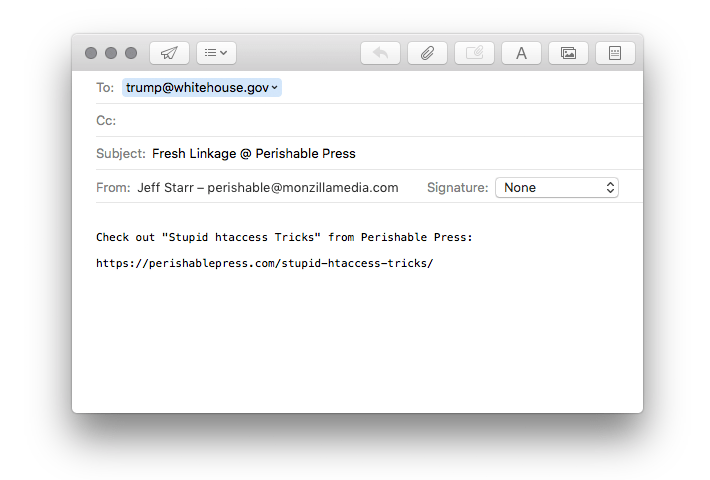
In addition to your choice collection of “Share This” links, you may also want to provide visitors with a link that enables them to quickly and easily send the URL permalink of any post to their friends via email. This is a great way to increase your readership and further your influence. Just copy & paste the following code into the desired location in your page template: <a href="mailto:?subject=Fresh%20Linkage%20@%20Perishable%20Press&body=Check%20out%20<?php the_permalink(); ?>%20from%20Perishable%20Press" title="Send a link to this post via email" rel="nofollow">Share […] Continue reading »
Canonical URLs are important for maintaining consistent linkage, reducing duplicate content issues, and increasing the overall integrity of your site. In addition to cleaning up trailing slashes and removing extraneous index.php and index.html strings, removing the www subdirectory prefix is an excellent way to shorten links and deliver consistent, canonical URLs. Of course, an optimal way of removing (or adding) the www prefix is accomplished via HTAccess canonicalization: Continue reading »
One of the oldest JavaScript tricks in the book involves providing a “print this!” link for visitors that enables them to summon their operating system’s default print dialogue box to facilitate quick and easy printing of whatever page they happen to be viewing. With the old way of pulling this little stunt, we write this in the markup comprising the target “print this!” link in question: Continue reading »

 Perishable Press is operated by Jeff Starr, a professional web developer and book author with two decades of experience.
Here you will find posts about web development, WordPress, security, and
Perishable Press is operated by Jeff Starr, a professional web developer and book author with two decades of experience.
Here you will find posts about web development, WordPress, security, and