![[ WP Cron HTTP Auth ]](https://perishablepress.com/wp/wp-content/images/2011/code-snippets-collection.jpg)
Please excuse this self-serving, miscellaneous post, but I’ve just got to purge all of these code snippets and scraps collected over the years. Whenever I update this site, I place any removed/unused code snippets into a giant note file for future reference, just in case. There’s all sorts of different types of code and snippets that just keep growing and growing and.. and finally it gets to a point where I just need to dump everything and start fresh. Welcome […] Continue reading »
![[ Screenshot: Editable and non-editable file permissions in Plesk ]](https://perishablepress.com/wp/wp-content/images/2011/upload-files/file-permissions-01.jpg)
I recently spent some time wrestling with various e-commerce/shopping-cart/membership plugins. One of them was of course the popular WP e-Commerce plugin, which uses a directory named “downloadables” to store your precious goods. I had some large files that needed to go into this folder, but the server’s upload limit stopped me from using the plugin’s built-in file uploader to do so. Continue reading »
You know when you you’re working on a project and get stuck on something, so you scour the Web for solutions only to find that everyone else seems to be experiencing the exact same thing. Then, after many hours trying everything possible, you finally stumble onto something that seems to work. This time, the project was setting up a secure downloads area for Digging into WordPress. And when I finally discovered a solution, I told myself that it was definitely […] Continue reading »
![[ Enjoying the Evening ]](https://perishablepress.com/wp/wp-content/images/2010/misc-chunks/secure-phpinfo.jpg)
Whenever I find myself working with PHP or messing around with server settings, I nearly always create a phpinfo.php file and place it in the root directory of whatever domain I happen to be working on. These types of informational files employ PHP’s handy phpinfo() function to display a concise summary of all of your server’s variables, which may then be referenced for debugging purposes, bragging rights, and so on. While this sort of thing is normally okay, I frequently […] Continue reading »
![[ WordPress ]](https://perishablepress.com/wp/wp-content/images/2009/misc-chunks/wordpress-logo-blue.png)
One of the most popular articles here at Perishable Press is my January 2005 post, Stupid htaccess Tricks. In that article, I bring together an extensive collection of awesome copy-&-paste HTAccess code snippets. Four years later, people continue to tell me how much they enjoy and use the content as a bookmarked reference for many of their HTAccess needs. The article was even published in a book on Joomla! Security. This is very inspiring to me, so I have decided […] Continue reading »
![[ Screenshot: Default Apache 404 Error Page ]](https://perishablepress.com/wp/wp-content/images/2009/pimp-your-404/404-not-found.png)
I have been wanting to write about 404 error pages for quite awhile now. They have always been very important to me, with customized error pages playing a integral part of every well-rounded web-design strategy. Rather than try to re-invent the wheel with this, I think I will just go through and discuss some thoughts about 404 error pages, share some useful code snippets, and highlight some suggested resources along the way. In a sense, this post is nothing more […] Continue reading »
![[ Content Thieves and Other Scumbags ]](https://perishablepress.com/wp/wp-content/images/2009/misc-chunks/content-thieves.jpg)
Stolen content is the bane of every blogger who provides a publicly available RSS feed. By delivering your content via feed, you make it easy for scrapers to assimilate and re-purpose your material on their crap Adsense sites. It’s bad enough that someone would re-post your entire feed without credit, but to use it for cheap money-making schemes is about as pathetic as it gets. If you’re lucky, the bastards may leave all the links intact, so at least you […] Continue reading »
The shared server on which I host Perishable Press was recently scanned by security software that revealed a significant security risk. Namely, the HTTP request methods TRACE and TRACK were found to be enabled on my webserver. The TRACE and TRACK protocols are HTTP methods used in the debugging of webserver connections. Although these methods are useful for legitimate purposes, they may compromise the security of your server by enabling cross-site scripting attacks (XST). By exploiting certain browser vulnerabilities, an […] Continue reading »
Recently a reader asked about how to password-protect a directory for every specified IP while allowing open access to everyone else. In my article, Stupid htaccess Tricks, I show how to password-protect a directory for every IP except the one specified, but not for the reverse case. In this article, I will demonstrate this technique along with a wide variety of other useful password-protection tricks, including a few from my Stupid htaccess Tricks article. Before getting into the juicy stuff, […] Continue reading »
![[ Screenshot: The Legion of Doom ]](https://perishablepress.com/wp/wp-content/images/2009/misc-chunks/multiple-addresses.jpg)
Let’s face it. There’s just as much scum on the Internet as there is out there in the “real world.” Maybe even more, who knows. From scammers and spammers to scrapers and crackers, the Web is just crawling with all sorts of pathetic scumbags. As predictably random as much of the malicious activity happens to be, it is virtually guaranteed that you will be hounded by at least a few persistent IP addresses that, for whatever reason, have latched on […] Continue reading »
Normally, when visitors post a comment to your site, specific types of client data are associated with the request. Commonly, a client will provide a user agent, a referrer, and a host header. When any of these variables is absent, there is good reason to suspect foul play. For example, virtually all browsers provide some sort of user-agent name to identify themselves. Conversely, malicious scripts directly posting spam and other payloads to your site frequently operate without specifying a user […] Continue reading »
When designing sites, it is often useful to identify different pages by adding an ID attribute to the <body></body> element. Commonly, the name of the page is used as the attribute value, for example: <body id="about"></body> In this case, “about” would be the body ID for the “About” page, which would be named something like “about.php”. Likewise, other pages would have unique IDs as well, for example: <body id="archive"> </body><body id="contact"> </body><body id="subscribe"> </body><body id="portfolio"></body> ..again, with each ID associated […] Continue reading »
![[ Screenshot: WP Default Database Error Page ]](https://perishablepress.com/wp/wp-content/images/2009/install-security/h4x0rd_03.gif "Error establishing a database connection")
The other day, my server crashed and Perishable Press was unable to connect to the MySQL database. Normally, when WordPress encounters a database error, it delivers a specific error message similar to the following: Continue reading »
Given my propensity to discuss matters involving error log data (e.g., monitoring malicious behavior, setting up error logs, and creating extensive blacklists), I am often asked about the best way to go about monitoring 404 and other types of server errors. While I consider myself to be a novice in this arena (there are far brighter people with much greater experience), I do spend a lot of time digging through log entries and analyzing data. So, when asked recently about […] Continue reading »
You have seen user-agent blacklists, IP blacklists, 4G Blacklists, and everything in between. Now, in this article, for your sheer and utter amusement, I present a collection of over 8000 blacklisted referrers. Shortcut: skip the article and jump to Disclaimer and Download » Referrer Spam Sucks For the uninitiated, in teh language of teh Web, a referrer is the online resource from whence a visitor happened to arrive at your site. For example, if Johnny the Wonder Parrot was visiting the […] Continue reading »
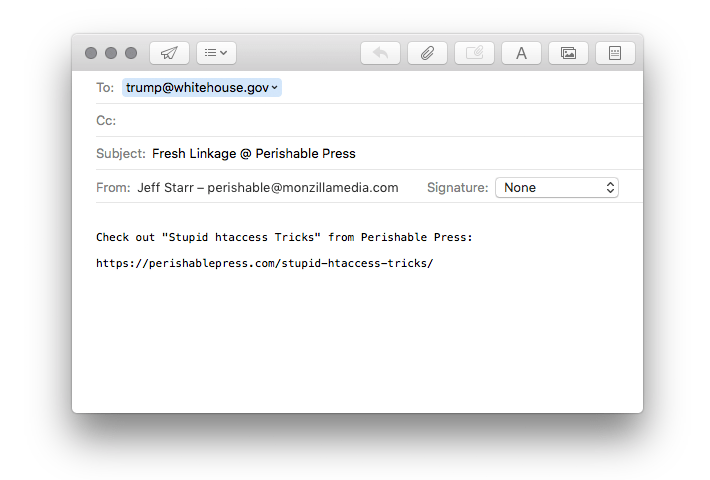
In addition to your choice collection of “Share This” links, you may also want to provide visitors with a link that enables them to quickly and easily send the URL permalink of any post to their friends via email. This is a great way to increase your readership and further your influence. Just copy & paste the following code into the desired location in your page template: <a href="mailto:?subject=Fresh%20Linkage%20@%20Perishable%20Press&body=Check%20out%20<?php the_permalink(); ?>%20from%20Perishable%20Press" title="Send a link to this post via email" rel="nofollow">Share […] Continue reading »

 Perishable Press is operated by Jeff Starr, a professional web developer and book author with two decades of experience.
Here you will find posts about web development, WordPress, security, and
Perishable Press is operated by Jeff Starr, a professional web developer and book author with two decades of experience.
Here you will find posts about web development, WordPress, security, and