Given my propensity to discuss matters involving error log data (e.g., monitoring malicious behavior, setting up error logs, and creating extensive blacklists), I am often asked about the best way to go about monitoring 404 and other types of server errors. While I consider myself to be a novice in this arena (there are far brighter people with much greater experience), I do spend a lot of time digging through log entries and analyzing data. So, when asked recently about […] Continue reading »
Importing and displaying external RSS feeds on your site is a great way to share your online activity with your visitors. If you are active on Flickr, Delicious, Twitter, or Tumblr, your visitors will enjoy staying current with your updates. Many social media sites provide exclusive feeds for user-generated content that may be imported and displayed on virtually any web page. In this article, you will learn three ways to import and display feed content on your WordPress-powered website — […] Continue reading »
You have seen user-agent blacklists, IP blacklists, 4G Blacklists, and everything in between. Now, in this article, for your sheer and utter amusement, I present a collection of over 8000 blacklisted referrers. Shortcut: skip the article and jump to Disclaimer and Download » Referrer Spam Sucks For the uninitiated, in teh language of teh Web, a referrer is the online resource from whence a visitor happened to arrive at your site. For example, if Johnny the Wonder Parrot was visiting the […] Continue reading »
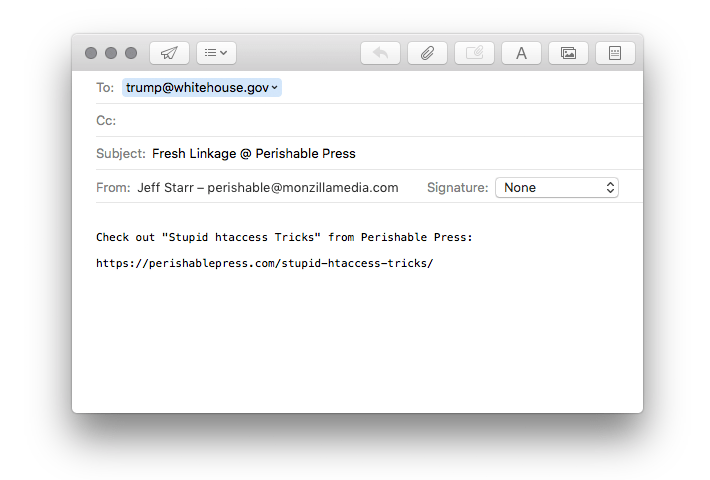
In addition to your choice collection of “Share This” links, you may also want to provide visitors with a link that enables them to quickly and easily send the URL permalink of any post to their friends via email. This is a great way to increase your readership and further your influence. Just copy & paste the following code into the desired location in your page template: <a href="mailto:?subject=Fresh%20Linkage%20@%20Perishable%20Press&body=Check%20out%20<?php the_permalink(); ?>%20from%20Perishable%20Press" title="Send a link to this post via email" rel="nofollow">Share […] Continue reading »
![[ Image: Inverted Eclipse ]](https://perishablepress.com/wp/wp-content/images/2009/agent-blacklist/inverted-eclipse.jpg)
As discussed in my recent article, Eight Ways to Blacklist with Apache’s mod_rewrite, one method of stopping spammers, scrapers, email harvesters, and malicious bots is to blacklist their associated user agents. Apache enables us to target bad user agents by testing the user-agent string against a predefined blacklist of unwanted visitors. Any bot identifying itself as one of the blacklisted agents is immediately and quietly denied access. While this certainly isn’t the most effective method of securing your site against […] Continue reading »
Check out this sweet composition of aural styles discovered in the stylesheet for the W3C’s website: /* AURAL STYLES (via W3C) */ @media aural { h1, h2, h3, h4, h5, h6 { voice-family: paul, male; stress: 20; richness: 90 } h1 { pitch: x-low; pitch-range: 90 } h2 { pitch: x-low; pitch-range: 80 } h3 { pitch: low; pitch-range: 70 } h4 { pitch: medium; pitch-range: 60 } h5 { pitch: medium; pitch-range: 50 } h6 { pitch: medium; pitch-range: […] Continue reading »
![[ 4G Stormtrooper ]](https://perishablepress.com/wp/wp-content/images/2009/misc-chunks/stormtrooper-4g.jpg)
At last! After many months of collecting data, crafting directives, and testing results, I am thrilled to announce the release of the 4G Blacklist! The 4G Blacklist is a next-generation protective firewall that secures your site against a wide range of automated attacks and other malicious activity. Continue reading »
![[ Building the Hoover Dam, Part 1 ]](https://perishablepress.com/wp/wp-content/images/2009/building-4g/hoover-dam_01.jpg)
Last year, after much research and discussion, I built a concise, lightweight security strategy for Apache-powered websites. Prior to the development of this strategy, I relied on several extensive blacklists to protect my sites against malicious user agents and IP addresses. Unfortunately, these mega-lists eventually became unmanageable and ineffective. As increasing numbers of attacks hit my server, I began developing new techniques for defending against external threats. This work soon culminated in the release of a “next-generation” blacklist that works […] Continue reading »
In my recent article on blocking proxy servers, I explain how to use HTAccess to deny site access to a wide range of proxy servers. The method works great, but some readers want to know how to allow access for specific proxy servers while denying access to as many other proxies as possible. Fortunately, the solution is as simple as adding a few lines to my original proxy-blocking method. Specifically, we may allow any requests coming from our whitelist of […] Continue reading »
Canonical URLs are important for maintaining consistent linkage, reducing duplicate content issues, and increasing the overall integrity of your site. In addition to cleaning up trailing slashes and removing extraneous index.php and index.html strings, removing the www subdirectory prefix is an excellent way to shorten links and deliver consistent, canonical URLs. Of course, an optimal way of removing (or adding) the www prefix is accomplished via HTAccess canonicalization: Continue reading »
One of the oldest JavaScript tricks in the book involves providing a “print this!” link for visitors that enables them to summon their operating system’s default print dialogue box to facilitate quick and easy printing of whatever page they happen to be viewing. With the old way of pulling this little stunt, we write this in the markup comprising the target “print this!” link in question: Continue reading »
Shortest post ever! You can quickly and easily apply transparency to any supportive element by adding the following CSS code your stylesheet: selector { filter: alpha(opacity=50); /* internet explorer */ -khtml-opacity: 0.5; /* khtml, old safari */ -moz-opacity: 0.5; /* mozilla, netscape */ opacity: 0.5; /* fx, safari, opera */ } Check the code comments to see what’s doing what, and feel free to adjust the level of transparency by editing the various property values. Also, remember to replace “selector” […] Continue reading »
![[ CSS3 ]](https://perishablepress.com/wp/wp-content/images/2008/misc-chunks/css-logo.jpg)
I have written previously on the fine art of preloading images without JavaScript using only CSS. These caching techniques have evolved in terms of effectiveness and accuracy, but may be improved further to allow for greater cross-browser functionality. In this post, I share a “CSS-only” preloading method that works better under a broader set of conditions. Previous image-preloading techniques target all browsers, devices, and media types. Unfortunately, certain browsers do not load images that are hidden directly (via the <img […] Continue reading »
![[ Image: Abstract Mathematical Diagram ]](https://perishablepress.com/wp/wp-content/images/2009/misc-chunks/temp-redirect.jpg)
In my previous article on temporarily redirecting visitors during site updates, I present numerous PHP and HTAccess methods for handling traffic during site maintenance, updates, and other temporary periods of downtime. Each of the PHP methods presented in the article allow for access from a single IP while redirecting everyone else. In this article, we modify our previous techniques to allow access for multiple IP addresses while temporarily redirecting everyone else to the page of our choice. Plus, while we’re […] Continue reading »
Working a great deal with blacklists, I am frequently trying to isolate and identify problematic code. For example, a blacklist implementation may suddenly prevent a certain type of page from loading. In order to resolve the issue, the blacklist is immediately removed and tested for the offending directive(s). This situation is common to other coding languages as well, especially when dealing with CSS. Identifying problem code is more of an art form than a science, but fortunately, there are a […] Continue reading »
Earlier this year, I posted an article explaining how to implement an unobtrusive JavaScript dynamic clock. While not completely earth-shattering or cutting-edge or anything like that, the dynamic JavaScript clock has received some great feedback from users who found the script to be exactly what they were looking for. In fact, a couple of weeks ago, Bill Brown went above and beyond by taking the time to improve the script with some great new features, including a “blinking seconds separator […] Continue reading »

 Perishable Press is operated by Jeff Starr, a professional web developer and book author with two decades of experience.
Here you will find posts about web development, WordPress, security, and
Perishable Press is operated by Jeff Starr, a professional web developer and book author with two decades of experience.
Here you will find posts about web development, WordPress, security, and 