You have seen user-agent blacklists, IP blacklists, 4G Blacklists, and everything in between. Now, in this article, for your sheer and utter amusement, I present a collection of over 8000 blacklisted referrers. Shortcut: skip the article and jump to Disclaimer and Download » Referrer Spam Sucks For the uninitiated, in teh language of teh Web, a referrer is the online resource from whence a visitor happened to arrive at your site. For example, if Johnny the Wonder Parrot was visiting the […] Continue reading »
![[ Image: Inverted Eclipse ]](https://perishablepress.com/wp/wp-content/images/2009/agent-blacklist/inverted-eclipse.jpg)
As discussed in my recent article, Eight Ways to Blacklist with Apache’s mod_rewrite, one method of stopping spammers, scrapers, email harvesters, and malicious bots is to blacklist their associated user agents. Apache enables us to target bad user agents by testing the user-agent string against a predefined blacklist of unwanted visitors. Any bot identifying itself as one of the blacklisted agents is immediately and quietly denied access. While this certainly isn’t the most effective method of securing your site against […] Continue reading »
![[ 4G Stormtrooper ]](https://perishablepress.com/wp/wp-content/images/2009/misc-chunks/stormtrooper-4g.jpg)
At last! After many months of collecting data, crafting directives, and testing results, I am thrilled to announce the release of the 4G Blacklist! The 4G Blacklist is a next-generation protective firewall that secures your site against a wide range of automated attacks and other malicious activity. Continue reading »
![[ Building the Hoover Dam, Part 1 ]](https://perishablepress.com/wp/wp-content/images/2009/building-4g/hoover-dam_01.jpg)
Last year, after much research and discussion, I built a concise, lightweight security strategy for Apache-powered websites. Prior to the development of this strategy, I relied on several extensive blacklists to protect my sites against malicious user agents and IP addresses. Unfortunately, these mega-lists eventually became unmanageable and ineffective. As increasing numbers of attacks hit my server, I began developing new techniques for defending against external threats. This work soon culminated in the release of a “next-generation” blacklist that works […] Continue reading »
![[ #1 ]](https://perishablepress.com/wp/wp-content/images/2009/eight-blacklist/01.gif)
With the imminent release of the next series of (4G) blacklist articles here at Perishable Press, now is the perfect time to examine eight of the most commonly employed blacklisting methods achieved with Apache’s incredible rewrite module, mod_rewrite. In addition to facilitating site security, the techniques presented in this article will improve your understanding of the different rewrite methods available with Apache mod_rewrite. Note: I changed the title of this post from “Eight Ways to Blacklist..” to “Eight Ways to […] Continue reading »
Here’s the scene: you have been noticing a large number of 404 requests coming from a particular domain. You check it out and realize that the domain in question has a number of misdirected links to your site. The links may resemble legitimate URLs, but because of typographical errors, markup errors, or outdated references, they are broken, leading to nowhere on your site and producing a nice 404 error for every request. Ugh. Or, another painful scenario would be a […] Continue reading »
Time for another Feedburner redirect tutorial! In our previous FeedBurner-redirect post, I provide an improved HTAccess method for redirecting your site’s main feed and comment feed to their respective Feedburner URLs. In this tutorial, we are redirecting individual WordPress category feeds to their respective FeedBurner URLs. We will also look at the complete code required to redirect all of the above: the main feed, comments feed, and of course any number of individual category feeds. Let’s jump into it.. Continue reading »
![[ Screenshot: Default Directory View ]](https://perishablepress.com/wp/wp-content/images/2008/directories/directory.gif "Says what it is, is what it says..")
Beautify your default directory listings! Displaying index-less file views is a great way to share files, but the drab, bare-bones interface is difficult to integrate into existing designs. While there are many scripts available to customize the appearance and functionality of default directory navigation, most of these methods are either too complicated, too invasive, or otherwise insufficient for expedient directory styling. In this comprehensive tutorial, you will learn how to use the built-in functionality of Apache’s mod_autoindex module to style […] Continue reading »
Recently, a client wanted to deliver her blog feed through Feedburner to take advantage of its excellent statistical features. Establishing a Feedburner-delivered feed requires three things: a valid feed URL, a Feedburner account, and a redirect method. For permalink-enabled WordPress feed URLs, configuring the required redirect is straightforward: either install the Feedburner Feedsmith plugin or use an optimized HTAccess technique. Unfortunately, for sites without permalinks enabled, the Feedsmith plugin is effectively useless, and virtually all of the HTAccess methods currently […] Continue reading »
One of the most useful techniques in my HTAccess toolbox involves URL redirection using Apache’s RedirectMatch directive. With RedirectMatch, you get the powerful regex pattern matching available in the mod_alias module combined with the simplicity and effectiveness of the Redirect directive. This hybrid functionality makes RedirectMatch the ideal method for highly specific redirection. In this tutorial, we will explore the application of RedirectMatch as it applies to one of the most difficult redirect scenarios: redirecting all requests for a specific […] Continue reading »
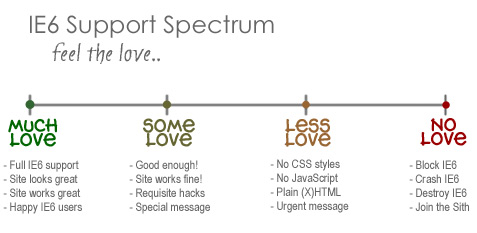
I know, I know, not another post about IE6! I actually typed this up a couple of weeks ago while immersed in my site redesign project. I had recently decided that I would no longer support that terrible browser, and this tangential post just kind of “fell out.” I wasn’t sure whether or not to post it, but I recently decided to purge my draft stash by posting everything for your reading pleasure. Thus, you may see a few turds […] Continue reading »
In my previous article on redirecting 404 requests for favicon files, I presented an HTAccess technique for redirecting all requests for nonexistent favicon.ico files to the actual file located in the site’s web-accessible root directory: # REDIRECT FAVICONZ <ifmodule mod_rewrite.c> RewriteCond %{THE_REQUEST} favicon.ico [NC] RewriteRule (.*) http://domain.tld/favicon.ico [R=301,L] </ifmodule> As discussed in the article, this code is already in effect here at Perishable Press, as may be seen by clicking on any of the following links: Update: I’ve removed the […] Continue reading »
For the last several months, I have been seeing an increasing number of 404 errors requesting “favicon.ico” appended onto various URLs: http://example.com/favicon.ico http://example.com/2007/06/12/favicon.ico http://example.com/2007/09/25/absolute-horizontal-and-vertical-centering-via-css/favicon.ico http://example.com/2007/08/01/temporary-site-redirect-for-visitors-during-site-updates/favicon.ico http://example.com/2007/01/16/maximum-and-minimum-height-and-width-in-internet-explorer/favicon.ico When these errors first began appearing in the logs several months ago, I didn’t think too much of it — “just another idiot who can’t find my site’s favicon..” As time went on, however, the frequency and variety of these misdirected requests continued to increase. A bit frustrating perhaps, but not serious enough to […] Continue reading »
![[ 3G Stormtrooper ]](https://perishablepress.com/wp/wp-content/images/2008/blacklist-3g/blacklist-series_00.jpg)
In the now-complete series, Building the 3G Blacklist, I share insights and discoveries concerning website security and protection against malicious attacks. Each article in the series focuses on unique blacklist strategies designed to protect sites transparently, effectively, and efficiently. The five articles culminate in the release of the next generation 3G Blacklist. Here is a quick summary of the entire Building the 3G Blacklist series: Continue reading »
As you know, HTAccess files are powerful tools for manipulating site performance and functionality. Protecting your site’s HTAccess files is critical to maintaining a secure environment. Fortunately, preventing access to your HTAccess files is very easy. Let’s have a look.. Continue reading »
![[ 3G Stormtroopers ]](https://perishablepress.com/wp/wp-content/images/2008/blacklist-3g/blacklist-release.jpg)
After much research and discussion, I have developed a concise, lightweight security strategy for Apache-powered websites. Prior to the development of this strategy, I relied on several extensive blacklists to protect my sites against malicious user agents and IP addresses. Over time, these mega-lists became unmanageable and ineffective. As increasing numbers of attacks hit my server, I began developing new techniques for defending against external threats. This work soon culminated in the release of a “next-generation” blacklist that works by […] Continue reading »

 Perishable Press is operated by Jeff Starr, a professional web developer and book author with two decades of experience.
Here you will find posts about web development, WordPress, security, and
Perishable Press is operated by Jeff Starr, a professional web developer and book author with two decades of experience.
Here you will find posts about web development, WordPress, security, and