One way to prevent Google from crawling certain pages is to use <meta /> elements in the <head></head> section of your web documents. For example, if I want to prevent Google from indexing and archiving a certain page, I would add the following code to the head of my document: Continue reading »
Given my propensity to discuss matters involving error log data (e.g., monitoring malicious behavior, setting up error logs, and creating extensive blacklists), I am often asked about the best way to go about monitoring 404 and other types of server errors. While I consider myself to be a novice in this arena (there are far brighter people with much greater experience), I do spend a lot of time digging through log entries and analyzing data. So, when asked recently about […] Continue reading »
You have seen user-agent blacklists, IP blacklists, 4G Blacklists, and everything in between. Now, in this article, for your sheer and utter amusement, I present a collection of over 8000 blacklisted referrers. Shortcut: skip the article and jump to Disclaimer and Download » Referrer Spam Sucks For the uninitiated, in teh language of teh Web, a referrer is the online resource from whence a visitor happened to arrive at your site. For example, if Johnny the Wonder Parrot was visiting the […] Continue reading »
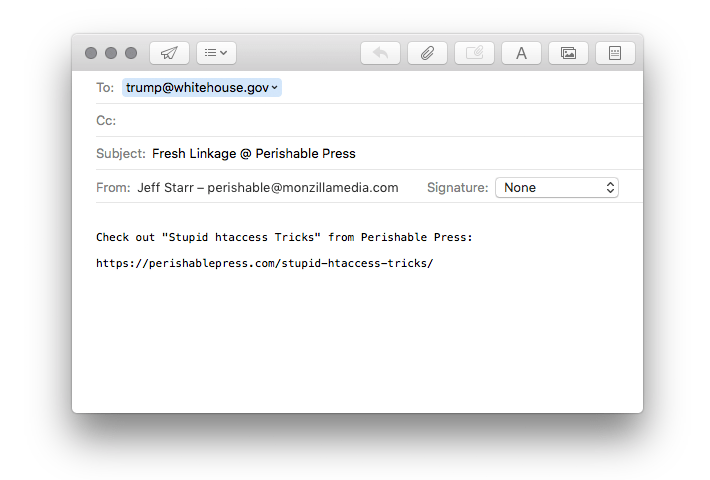
In addition to your choice collection of “Share This” links, you may also want to provide visitors with a link that enables them to quickly and easily send the URL permalink of any post to their friends via email. This is a great way to increase your readership and further your influence. Just copy & paste the following code into the desired location in your page template: <a href="mailto:?subject=Fresh%20Linkage%20@%20Perishable%20Press&body=Check%20out%20<?php the_permalink(); ?>%20from%20Perishable%20Press" title="Send a link to this post via email" rel="nofollow">Share […] Continue reading »
![[ Image: Inverted Eclipse ]](https://perishablepress.com/wp/wp-content/images/2009/agent-blacklist/inverted-eclipse.jpg)
As discussed in my recent article, Eight Ways to Blacklist with Apache’s mod_rewrite, one method of stopping spammers, scrapers, email harvesters, and malicious bots is to blacklist their associated user agents. Apache enables us to target bad user agents by testing the user-agent string against a predefined blacklist of unwanted visitors. Any bot identifying itself as one of the blacklisted agents is immediately and quietly denied access. While this certainly isn’t the most effective method of securing your site against […] Continue reading »
![[ 4G Stormtrooper ]](https://perishablepress.com/wp/wp-content/images/2009/misc-chunks/stormtrooper-4g.jpg)
At last! After many months of collecting data, crafting directives, and testing results, I am thrilled to announce the release of the 4G Blacklist! The 4G Blacklist is a next-generation protective firewall that secures your site against a wide range of automated attacks and other malicious activity. Continue reading »
I really hate bad robots. When a web crawler, spider, bot — or whatever you want to call it — behaves in a way that is contrary to expected and/or accepted protocols, we say that the bot is acting suspiciously, behaving badly, or just acting stupid in general. Unfortunately, there are thousands — if not hundreds of thousands — of nefarious bots violating our sites every minute of the day. For the most part, there are effective methods available enabling […] Continue reading »
![[ Building the Hoover Dam, Part 1 ]](https://perishablepress.com/wp/wp-content/images/2009/building-4g/hoover-dam_01.jpg)
Last year, after much research and discussion, I built a concise, lightweight security strategy for Apache-powered websites. Prior to the development of this strategy, I relied on several extensive blacklists to protect my sites against malicious user agents and IP addresses. Unfortunately, these mega-lists eventually became unmanageable and ineffective. As increasing numbers of attacks hit my server, I began developing new techniques for defending against external threats. This work soon culminated in the release of a “next-generation” blacklist that works […] Continue reading »
![[ #1 ]](https://perishablepress.com/wp/wp-content/images/2009/eight-blacklist/01.gif)
With the imminent release of the next series of (4G) blacklist articles here at Perishable Press, now is the perfect time to examine eight of the most commonly employed blacklisting methods achieved with Apache’s incredible rewrite module, mod_rewrite. In addition to facilitating site security, the techniques presented in this article will improve your understanding of the different rewrite methods available with Apache mod_rewrite. Note: I changed the title of this post from “Eight Ways to Blacklist..” to “Eight Ways to […] Continue reading »
![[ Miscellaneous Color Slices ]](https://perishablepress.com/wp/wp-content/images/2008/misc-chunks/misc-snippets.jpg)
One of the original purposes of Perishable Press involved serving as a “virtual dumpster” for all of my miscellaneous code snippets. Over time, I continued elaborating to greater degrees on the various code recipes that I was posting, until eventually those brief snippet posts evolved into complete, richly detailed articles (at least from my point of view). Now that I enjoy the luxury of writing for an incredible audience, I try to avoid posting anything that doesn’t include an accompanying […] Continue reading »
Ever wanted to provide automatic language translations of your web pages without installing another plugin? Here is a valid, SEO-friendly technique that takes advantage of Google’s free translation service. All you need is a PHP-enabled server and you’re good to go. Just copy and paste the following code into the desired location in your page template and enjoy the results. Once in place, this code will produce translation links for eight common languages for every page on your site. Grab, […] Continue reading »
I recently added OpenSearch functionality to Perishable Press. Now, OpenSearch-enabled browsers such as Firefox and IE 7 alert users with the option to customize their browser’s built-in search feature with an exclusive OpenSearch-powered search option for Perishable Press. The autodiscovery feature of supportive browsers detects the custom search protocol and enables users to easily add it to their collection of readily available site-specific search options. Now, users may search the entire Perishable Press domain with the click of a button. […] Continue reading »
![[ Social Media ]](https://perishablepress.com/wp/wp-content/images/2008/misc-chunks/social-media-deco.png)
With the explosion of social media, networking, and bookmarking services, there are a zillion ways to add “Share This Post” functionality to your WordPress-powered sites. In addition to the myriad services and plugins, we can also add these links directly, using nothing more than a little markup and a few choice PHP snippets. Such individual links provide full control over the selection, layout, and styling of each link without requiring the installation of yet another WordPress plugin. This article shares […] Continue reading »
There are two possibilities here: Yahoo!’s Slurp crawler is broken or Yahoo! lies about obeying Robots directives. Either case isn’t good. Slurp just can’t seem to keep its nose out of my private business. And, as I’ve discussed before, this happens all the time. Here are the two most recent offenses, as recorded in the log file for my blackhole spider trap: Continue reading »
![[ Linux ]](https://perishablepress.com/wp/wp-content/images/2008/misc-chunks/linux.png)
Thanks to a complete (and I mean complete) collection of screenshots graciously sent in by Brent Terrazas, I have been enlightened as to my need for Linux. Looking over the screenshots, I see a great deal of variation — more so than any of the Mac or PC browsers at my disposal — in terms of how designs are rendered on various Linux-driven browsers. The obsessive-compulsive designer in me suddenly sees an incredible need for my own Linux setup — […] Continue reading »
An ongoing series of articles on the fine art of malicious exploit detection and prevention. Learn about preventing the sneaky mischievous and deceptive practices of some of the worst spammers, scrapers, crackers, and other scumbags on the Internet. Continue reading »

 Perishable Press is operated by Jeff Starr, a professional web developer and book author with two decades of experience.
Here you will find posts about web development, WordPress, security, and
Perishable Press is operated by Jeff Starr, a professional web developer and book author with two decades of experience.
Here you will find posts about web development, WordPress, security, and